Membrane Protein Structure Dynamics   (MPSD) 

Research group : Priv.Doz. Dr. Thomas Nawroth 

Study group  "Structure dynamics of flexible protein domains" 


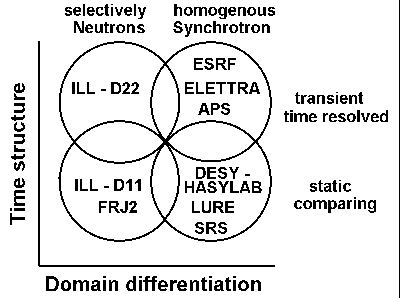
The study group "Structure dynamics of flexible protein domains" was established 1996 arrising from the former research focus VB42 funded by the german ministry of education, science and technology BMBF. This is a tight collaboration of several research groups interested in a common phaenomenon in protein structure. A "structure dynamics of flexible protein domains" may occur during protein reaction cycles or the regulation of the biological activity. It is a special form of molecular motion, which is here a long range displacement of large stable domains or subunits in and between complex proteins. This yields transient structural rearrangements in case of motions during reaction cycles and permanent structural rearrangements upon the allosteric regulation of the proteins. Because of the similarity of the phaenomena in several biological systems, the structural dynamics is investigated cooperatively by the open study group of five groups. Depending on the live time of the rearranged structure and domain structure of the object we apply several methods according to a concept of complementary methods and instruments of structure research:
The investigation of structural dynamics of biological macromolecules requires complementary methods and instruments.
.
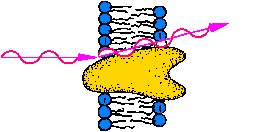
The role of molecular motion for biological function and regulation is investigated by comparison of structure and function of the proteins in their native state, i.e. as solution or bound to membranes. The structural study is done by static and time resolved neutron and X-ray small angle scattering, e.g. at ESRF, ELETTRA, ILL, DESY/HASYLAB, FZ-Jülich. The weaker national sources are used for comparing stable modifications and for estimation of reference spectra, whereas the high flux instruments are needed for time resolved studies, e.g. at ESRF-ID02, ELETTRA-SAXS and ILL-D22. Neutrons are used for distinguishing between domains of different material, e.g. lipids and protein, by contrast variation (deuteration). X-ray synchrotron radiation is used for the study homogenous molecules, or if the method of anomalous scattering can be applied, e.g. after reaction of protein or polymers with metal "lantern-labels".
The study group is active by sharing beam time at the above research centers and instruments. The experiment equipment is shared, which saves expenses and allows the use of special technical developments, e.g. our helium-jet cooled sample environments for time resolved X-ray scattering. For each common experiments a temporary experimentalist group of persons from the participating labs is formed. Thus newcommers can easily be introduced. The scientific work is improved by synergistic effects.
.
The current research objects and problems are:
- Prototon-translocating proteins (ATP-synthase, F1ATPase and Cytochrom-oxidases): Transient structures in the reaction cycles (structural film of working enzyme) and allosteric regulation; Membrane structure dynamics (Nawroth)
- Sodium-translocating ATP-synthase, F1ATPase: Comparison with the proton dependent enzymes (Dimroth/Nawroth)
- Oligomeric oxygen transport proteins (Hemocyanins): Role of the large protein complexes and allosteric regulation (Decker)
- Chaperonin GroEL : Transient structure dynamics upon folding catalysis of substrate protein and during formation of the active GroEL/ES complexes, locked intermediates (Heumann)
- Glycoprotein Clusterin (gp80): Structure dynamics upon binding of activating lipids (Koch-Brandt, Klock)
- Heme-proteins (Myoglobin, Peroxidase): Structure dynamics, regulation (Doster, Petry)
- Fast motions in proteins (Metalloproteins): Structure dynamics in the ns-scale (Parak)
- Motor proteins (Kinesin, Dynein): Structure dynamics, e.g. molecular motion (Mandelkow)

Currently the open study group currently consists of the following groups:
 
Inst. f. Biochemie, Universität Mainz, AG Membranenstruktur - Protein Dynamik PD. Dr. T. Nawroth
Max-Planck-Institut für Biochemie, Martinsried, Biophys. PD. Dr. H. Heumann
Inst. für molekulare Biophysik, Universität Mainz Prof. Dr. H. Decker
Inst. f. Biochemie, Universität Mainz, MolekularBiologie Prof. Dr. C. Koch-Brandt, PD. Dr. G. Klock
Physics Department, Institute E13, Technische Universität München TUM,  Garching PD. Dr. Wolfgang Doster, Prof. Dr. W. Petry
Physics Department, Institute E17, Technische Universität München TUM,  Garching Prof. Dr. F. Parak
Max-Planck-Arbeitsgruppen Strukturelle Biologie, c./o. DESY-HASYLAB, Hamburg Prof. Dr. E. Mandelkow
GKSS Forschungszentrum, Neutronenstreuung, Geesthacht Dr. R. Willumeit
.
Possible technical use: The developped methods shall be used for the investigation of flexible polymers capable of active motions, i.e. motile polymers.
.
If you are interested in participation, please send an email to nawroth@MPSD.de
If you like to try time resolved X-ray scattering we can help you to start, e.g. by investigation of enzyme kinetics in your lab or by static neutron or X-ray scattering experiments. For ATP-synthase/F1ATPase we can give you a "receipt" how to find out the proper conditions (It's not as difficult as you might think, but you have to observe thermokinetics and inhibitor-protein dissociation properly).


[ MAIN PAGE "Membrane Protein Structure Dynamics" (MPSD) ]
[ News | Address | Concepts | Science | Lectures | Technology | Publications | Health-Environment-Security | Thesis | Staff]
[ Structural Biology |Membrane Proteins| BioEnergetics | Molecular Motion | ATP-Synthase | Oxygen Proteins | Membrane Structure | NanoParticles ApplicationTime-Resolution | Computing | Study-Group ]


email to: nawroth@MPSD.de   update : 15.10.2002